
This guide compares hiring best practices from leading organisations.
These companies have been identified as pioneering recruitment innovations. The content summarizes how Amazon, Apple, Google, Meta, Microsoft, Uber, Tesla, and GE focus on key recruitment metrics. It also includes notable hiring best practices they employ.
Find Hiring Best Practices from 7 Global Companies
Amazon: Hiring Quality & Efficiency
Bar Raiser program ensures each hire raises the talent bar (driving quality). Metrics-driven culture: tracks time-to-fill and cost rigorously per team.
Uses structured interview process tied to Leadership Principles to evaluate cultural alignment. Leverages internal tools and automation to handle massive volume efficiently.
Apple: Candidate Quality & Experience:
Holistic candidate assessment – screens for innovation, collaboration, “Apple fit,” not just skills. Implements diverse interview panels to reduce bias.
Launched “Candidate Experience Initiative” to provide transparent, engaging process with regular feedback to all candidates. Broadened talent pool by removing strict degree requirements in job posts.
Google: Data-Driven Quality & Analytics
People Analytics guides hiring: eliminated brainteasers after data proved them useless; adopted structured behavioural interviews that are consistently applied.
Measures everything – interview scores vs performance, optimal interviews needed, etc. Very selective (0.2% hire rate), but ensures process is fair and efficient (hiring committees, standardized rubrics). Strong referral program and internal tools (e.g., “gHire”) to manage pipeline at low cost.
Meta: Speed & Effective Sources
Emphasizes employee referrals – a large percentage of hires come through internal networks, accelerating time-to-fill. Maintains a relatively fast interview process (often one on-site “loop”), to achieve high offer acceptance before candidates shop around.
Uses hiring data to refine interviewer training – e.g., calibrates how interview feedback correlates with new hire performance. Provides robust onboarding to ensure quality hires transition well (improving retention).
Microsoft: Inclusive Hiring & Retention
Pioneered programs like the Neurodiversity Hiring Program – a tailored recruitment and onboarding process for autistic candidates that improved hiring and retention of neurodiverse talent. Invests heavily in inclusive hiring training for managers (unconscious bias, structured interviews).
Strong on candidate experience: e.g., dedicated recruiters for follow-ups, and mentorship during the hiring process for senior candidates. Microsoft’s “inclusive culture” focus has made it more attractive – external surveys show increased candidate perception of Microsoft as welcoming, aiding offer acceptance.
Uber: Rapid Scale & Innovation
Faced hypergrowth, Uber turned to AI and automation to scale: implemented an AI screening tool which cut hiring time ~25% and improved quality. Combined traditional recruiting with creative methods – e.g., hackathons and coding challenges as hiring funnels, and partnerships with universities (20% of workforce from campus hires with 85% retention).
Employs metrics on recruiter performance (hires per recruiter per quarter) to drive efficiency. Uber’s iterative, metrics-driven approach exemplifies how a newer company can quickly adopt best practices to compete for talent with the big players.
Tesla: High Bar & Mission Appeal
Tesla’s brand and mission (“accelerate sustainable energy”) attract an enormous candidate pool, allowing high bar for its selection process. Uses that advantage to be picky – Elon Musk insisted on hiring only those truly driven by the mission. Recruitment focuses on finding “experts” and those with proven excellence (they often seek candidates with records of exceptional achievement, sometimes foregoing formal qualifications if experience shows capability).
Tesla relies a lot on direct applications (due to brand) and less on agencies, keeping cost per hire low. They are also using more structured interviews and assessments as the company matured, but the culture of urgency sometimes overrides a structured process.
Tesla’s recruiters often highlight the impact a hire will have to improve offer acceptance, offsetting the fact that other tech firms might offer higher pay or easier work-life balance.
GE: Strategic Alignment & Pipeline
Aligns recruiting with corporate strategy – GE systematically identifies what talent is needed for its strategic pillars. Talent management is GE’s most powerful tool for implementing their strategy.
Accordingly, GE tracks recruitment metrics like hires in key skill areas, internal fill rates for critical roles, and diversity in leadership pipeline. Uses an annual talent review (Session C) to integrate hiring plans with succession planning.
Measures quality by long-term success: known for hiring at entry-level and grooming leaders (so a metric might be percentage of officers who started as GE interns, for instance). By treating recruitment as a strategic function, GE ensures metrics like time-to-fill and cost are optimized in service of larger goals aligned with business needs.
In conclusion, each company leverages these measures differently.
In summary, Amazon and Google lean on data and high standards to drive quality, Apple and Microsoft prioritize culture and inclusion, Uber and Tesla bank on innovation and mission, and GE integrates recruiting with long-term strategy.
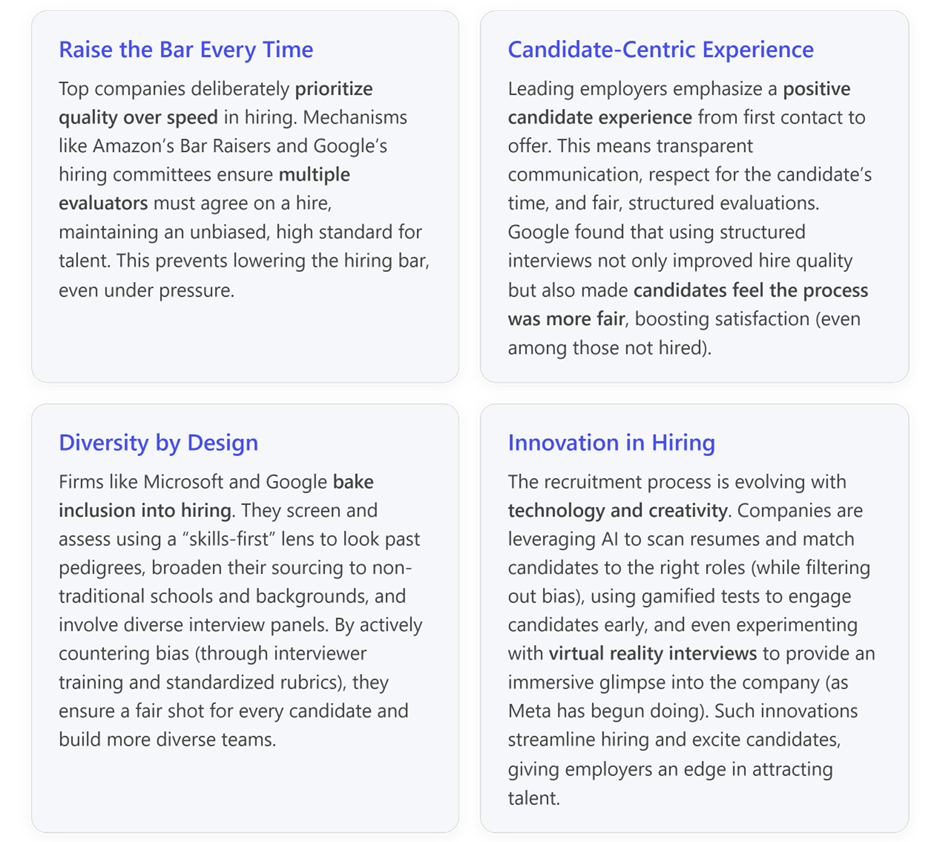
All of these organisations use metrics to continuously improve and they value that a great hire as worth the effort.
They recognize that speed, quality, cost, inclusion, and experience must be balanced to truly drive business value through recruitment.
You May Also Like
What is Quality of Hire? →
Quality of hire gauges how well new employees perform and contribute
Time to Hire Best Practices →
Here are 4 Practical ways to Improve Time to Hire
How to Manage Cost Per Hire →
Learn 3 ways High-performing firms improve hiring cost
Improve Candidate Experience →
Guide with 10 Ways To improve candidate satisfaction
Inclusive Hiring →
Track how well an organization is attracting and hiring candidates from underrepresented groups