
Structured interviews promote fairness and consistency. This practical guide will help hiring leaders on how to achieve better results from structured interviews.
Here are 6 structured interviews best practices:
1. First Principles of Interviewing
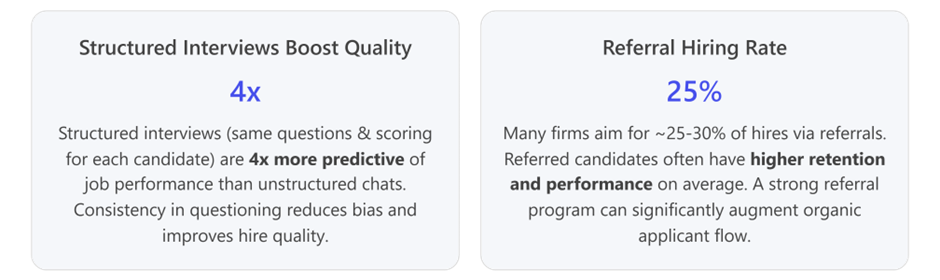
Ask all candidates the same job-relevant questions. Use scorecards or rubrics to rate responses. This method reduces bias and helps compare candidates objectively.
For example, when hiring for sales, focus on prospecting, closing, and teamwork. Ask scenario-based questions and rate answers on a clear scale.
Google adopted structured behavioural and situational interviews after internal studies showed unstructured formats were poor predictors. Research confirms structured interviews improve hiring accuracy.
Train interviewers to ask questions properly and stay on script. Teach them to take notes and rate independently before group discussions to avoid groupthink.
Many companies offer training or certification. Microsoft uses Interviewer Capability training. Amazon trains interviewers to map answers to Leadership Principles.
2. Behavioural and Situational Questions
Use behavioural (“Tell me about a time when…”) and situational (“How would you handle…”) questions to assess judgment and skills.
Focus scoring on actions and outcomes. Apply the STAR method (Situation, Task, Action, Result) to guide and evaluate answers.
3. Avoid Common Interview Pitfalls
First Impression Bias: Don’t let one trait influence the entire evaluation. Use multiple criteria to advance inclusive hiring.
Misusing Culture Fit: Define culture fit clearly. Ask about values like collaboration. Consider “culture add” to embrace diverse experiences.
Panel Overload: Limit the number of interviews. Assign each interviewer a distinct focus area.
Snap Judgments: Avoid deciding in the first few minutes. Encourage open-mindedness and team debriefs.
4. Candidate Experience at Interview
Candidates evaluate you during interviews. Be on time. Introduce interviewers with titles. Ask relevant questions. Avoid repetition by coordinating across interviewers. Leave time for candidate questions.
Communicate promptly after interviews. Aim for a respectful and engaging process. Even rejected candidates should feel valued.
5. Decision Making and Avoiding Mistakes
After interviews, hold a structured debrief. Each interviewer shares their assessment and hire/no-hire stance with evidence. The hiring manager and recruiter guide the discussion. Prioritize facts over gut feelings. If unsure, gather more data—perhaps a follow-up call. Don’t settle for a weak fit.
Amazon’s Bar Raiser program empowers a trained outsider to veto hires that don’t meet standards. Maintain long-term quality over quick fixes.
6. Managing Candidate Pipelines
Track candidate progress with an ATS. Keep candidates engaged with timely updates. Inform rejected candidates quickly. Keep strong runners-up warm in case the top choice declines. This improves time to hire rates and avoids restarting the process.
In Summary, structured, fair selection increases the chance of hiring someone who meets the role’s needs and leaves a positive impression.
Top recruitment teams follow disciplined processes and treat candidates as future colleagues—not just resumes.
You May Also Like
Interviews & Assessment →
In this stage, the shortlisted candidates undergo rigorous evaluation through interviews and specialized assessment.
What is Quality of Hire? →
Quality of hire gauges how well new employees perform and contribute
How to Improve Quality of Hire →
How to improve quality of hire, tapping into best practices from leading organizations
Time to Hire Best Practices→
Read 4 Practical ways to Improve Time to Hire
Improve Candidate Experience →
Guide with 10 Ways To improve candidate satisfaction