
Major HR technology platforms are integrating AI across their recruitment and talent management platforms to streamline hiring, enhance candidate experiences, and optimise internal mobility.
In the past year alone, this trend accelerated through strategic acquisitions and product innovations. Providers such as Workday, SAP SuccessFactors, Oracle Cloud HCM, and ADP have significantly expanded their AI capabilities.
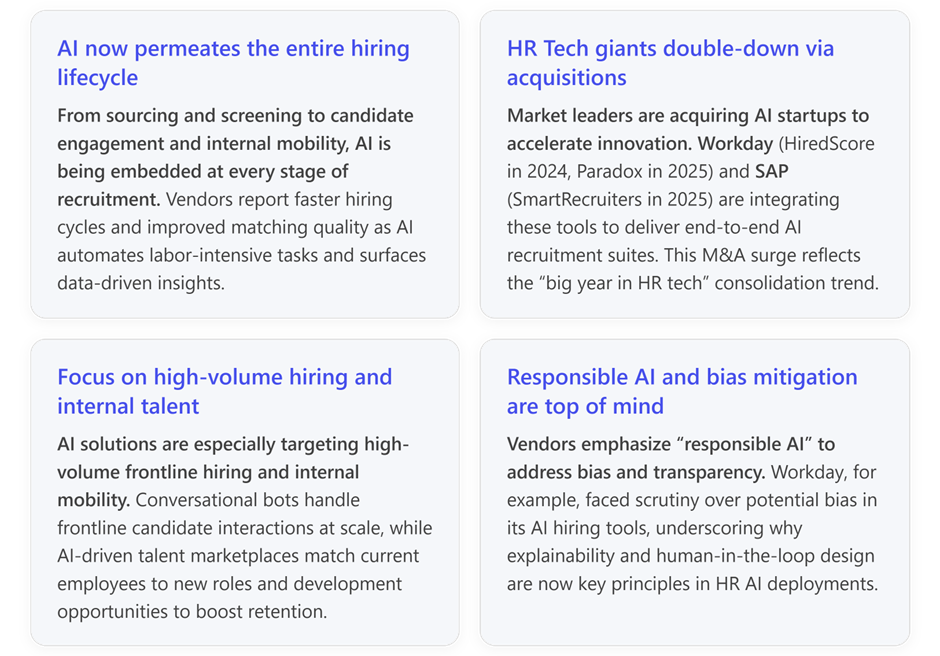
Below is a breakdown of how each platform is integrating AI into recruitment and talent functions—and what this means for hiring teams. We have previously written about Eightfold here.
AI Integration in HR Technology Platforms: Recent Developments
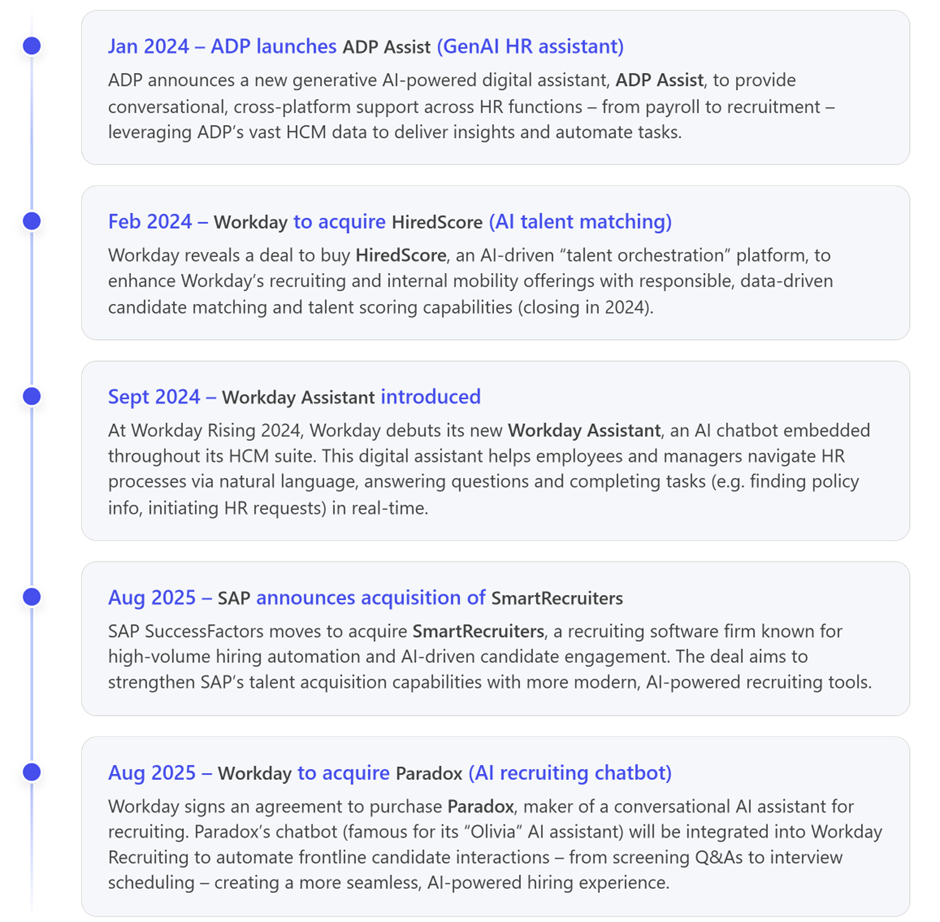
Workday: Building an End-to-End AI Hiring Ecosystem
Workday expanded its AI capabilities through acquisitions and internal development. In 2024, it acquired HiredScore (AI-powered screening and matching), and in 2025, Paradox (a conversational AI chatbot platform). These additions, alongside Workday’s Skills Cloud and Workday Assistant, position it as a leader in AI-driven recruitment.
Candidate Screening & Matching: Workday uses HiredScore’s machine learning to analyse CVs and match candidates to roles. Recruiters can now surface top talent—including internal candidates—more quickly and accurately. Early adopters report up to 30% faster time-to-hire and 20–30% higher recruiter productivity.
Conversational AI for High-Volume Hiring: Paradox’s chatbot engages candidates 24/7, automates interview scheduling, and handles FAQs. Workday’s integration enables rapid hiring for frontline roles. For example, Chipotle reduced time-to-hire from 12 days to 4 and doubled applicant flow using Paradox.
Generative AI for Recruiter Efficiency: Workday Assistant helps recruiters draft job descriptions, personalise outreach, and answer hiring manager queries. Surveys show 57% of recruiters complete postings faster and 45% automate routine tasks.
Internal Mobility: Workday combines HiredScore’s algorithms with its Talent Marketplace to match employees to internal roles and learning opportunities. This supports retention and career development, especially in competitive labour markets.
Hiring Impact: Recruiters using Workday benefit from faster screening, improved candidate engagement, and better internal mobility—all powered by explainable, responsible AI.
Oracle Cloud HCM: Embedding AI into the Redwood Experience
Oracle has taken an organic approach, building AI features directly into its Fusion Cloud HCM platform. Its Redwood UX refresh makes AI tools accessible and intuitive for recruiters and HR teams.
Automated Candidate Scoring: Oracle’s AI rates applicants based on education, experience, and skills. Recruiters receive dashboard summaries and can adjust weighting to refine matches.
Generative AI for Job Content: Oracle’s tools generate job descriptions, interview questions, and offer letters. This speeds up requisition creation and ensures consistency.
Digital Assistant for HR: Oracle’s chatbot handles candidate queries, schedules interviews, and provides analytics. Managers can request candidate lists or recruiting metrics via natural language.
Internal Mobility & Skills Development: Oracle’s Opportunity Marketplace and Dynamic Skills engine recommend roles, learning content, and career paths based on employee profiles.
Predictive Analytics: Oracle uses AI to forecast attrition, assess hiring sources, and guide workforce planning.
Hiring Impact: Oracle empowers recruiters with intelligent scoring, content generation, and predictive insights—streamlining hiring and supporting employee growth.
SAP SuccessFactors: Combining Acquisitions with AI Innovation
SAP is enhancing its Human Experience Management (HXM) suite by acquiring SmartRecruiters and building AI features internally.
SmartRecruiters Acquisition: SAP gains a next-gen ATS with AI resume scoring, automated scheduling, chatbots, and recruitment marketing. This modernises SAP’s recruiting module and improves candidate engagement.
AI Sourcing & Inclusive Hiring: SAP uses AI to parse CVs, recommend internal candidates, and reduce bias in job descriptions. Tools like Plum support psychometric assessments and inclusive hiring.
Conversational AI: SAP integrates SmartRecruiters’ chatbot with its own SAP Conversational AI platform. Candidates receive instant responses, interview scheduling, and personalised communication.
Internal Mobility & Career Coaching: SAP’s Opportunity Marketplace uses AI to match employees to roles, mentors, and learning paths. The system identifies skill gaps and recommends development opportunities.
AI for HR Decision Support: SAP’s People Analytics predicts flight risk, suggests hiring plans, and recommends learning content. Generative AI may soon assist with coaching feedback and policy drafting.
Hiring Impact: SAP offers a comprehensive AI-powered talent platform that supports both recruitment and retention. Recruiters benefit from automation, diversity tools, and internal mobility insights.
ADP: Leveraging Data and GenAI for Smarter HR
ADP focuses on data-driven AI, using its vast workforce dataset to deliver predictive insights and automation across HR functions.
DataCloud Insights: ADP’s analytics platform benchmarks time-to-fill, identifies bias in job posts, and recommends sourcing strategies. It uses data from over 40 million workers.
ADP Assist: This generative AI assistant simplifies HR tasks via chat. Recruiters can pull metrics, schedule interviews, and draft candidate messages—all through natural language.
Recruitment Automation: ADP’s recruiting modules screen CVs, highlight top matches, and distribute jobs programmatically. Clients can integrate third-party AI tools via ADP Marketplace.
Internal Mobility: ADP’s Career Mobility initiative uses AI to match employees to internal roles. It also recommends training and tracks career progression.
Ethical AI & Compliance: ADP prioritises responsible AI, with bias testing and strict data governance. It helps clients comply with emerging regulations like NYC’s AI audit law.
Hiring Impact: ADP delivers AI-powered recruiting and talent insights, especially for mid-sized firms. Its assistant and analytics tools improve productivity and support strategic hiring.
In conclusion, across these HR platforms, AI is transforming recruitment and talent management. These platforms are automating screening, scheduling, and candidate engagement. In addition, they enhance internal mobility through AI-driven career guidance and supporting recruiters with generative AI for content and decision-making.
For recruiting teams, this means faster processes, better candidate experiences, and smarter talent decisions.
You May Also Like
AI Integration Into HR Systems →
Seamless AI integration with HR systems for adopting AI in hiring.
Redesigning Workflows to Integrate AI →
Learn how companies are redesigning workflows to integrate AI.
AI in Recruitment Process (Industry Report) →
Industry report on how AI tools can be used in sourcing, screening and interviewing.
Eightfold AI: Talent Intelligence →
Eightfold AI delivers a comprehensive talent intelligence platform.
7 Risks from using AI in Recruitment →
Learn critical risks from using AI in Recruitment.