
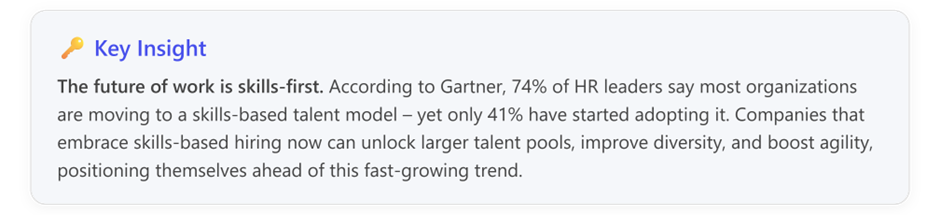
In today’s fast-evolving talent landscape, organisations are moving away from traditional job-based hiring and embracing a skills-based hiring model.
This approach prioritises what candidates can do—their skills and capabilities—over proxies such as degrees, job titles, or tenure. Adopting skills-based hiring has become essential for building a more agile, diverse, and high-performing workforce.
This report explains how a skills-first hiring model works, how it differs from competency-based approaches, and outlines practical steps for implementation, supported by real case studies and toolkits.
What is Skills Based Hiring?
Skills based hiring is where organisations prioritises candidate’s specific, transferable abilities over traditional qualifications like education and years of experience to match them with a job role.
In this approach, work is no longer confined to static job roles; skills is the currency of talent. Traditional roles with rigid descriptions have given way to more fluid, project-based work. A global Deloitte survey revealed that 63% of work occurs outside core job descriptions, and 81% spans across functional boundaries.
Employees consistently apply skills beyond their job titles. Additionally, 36% of work is now carried out by external contributors—contractors and gig workers—who do not hold formal roles within the organisation. This shift highlights the limitations of clinging to outdated job definitions.
“We’re beginning to think about each role as a collection of skills, rather than simply a job title.” – Anish Singh, Head of HR, Unilever ANZ
Unilever exemplifies this shift. The company has redesigned roles around skills through its internal “talent marketplace”, which breaks work into projects and tasks.
Employees and external “U-Workers” are matched to opportunities based on their skills and interests, not job titles.
This model dismantles departmental silos and focuses on outputs and capabilities, enabling faster and more accurate talent deployment.
It reflects the “skills-based organisation” model, where skills—not jobs—form the foundation of workforce planning.
Key Drivers Behind the Shift to Skills-First Hiring
Technology and Automation
The rise of AI and digital tools has shortened the shelf-life of many job skills. New skills such as prompt engineering and cloud technologies emerge rapidly, while older ones become obsolete. Analysts note that traditional competency models struggle to keep pace. To remain competitive, companies must hire individuals who can continuously learn and apply new skills.
Agility and Innovation
A skills-based approach enables organisations to pivot quickly. Assigning work based on skills allows talent to flow to where it’s needed most. Deloitte found that early adopters of skills-based practices are 63% more likely to meet changing business goals effectively. These organisations form agile teams that drive innovation and respond swiftly to change, unlike job-based models that confine talent to narrow roles.
Talent Shortages and Mobility
Hiring based on rigid criteria—such as specific degrees or exact job titles—limits the candidate pool. A skills-first approach significantly expands it.
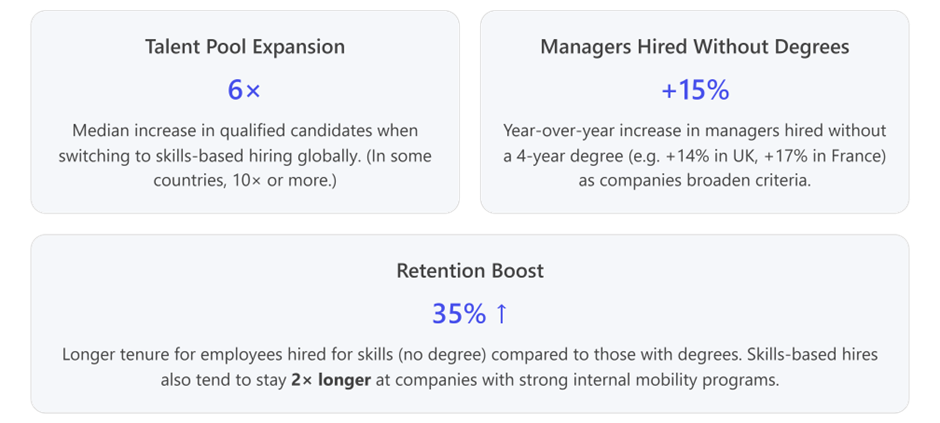
Research shows that defining candidates by skills rather than job titles can increase the qualified talent pool sixfold. In the US, skills-based hiring has been shown to increase the median number of eligible candidates for a role by nearly 16 times.
This method uncovers hidden talent and promotes internal mobility, allowing employees to transition into new roles based on transferable skills.
Diversity, Equity and Inclusion
Prioritising skills over credentials improves inclusive hiring. Many employers have removed strict degree requirements—often referred to as the “paper ceiling”—which disproportionately excluded capable candidates from underrepresented groups.
IBM, for example, reduced its degree requirements from 95% of roles to under 50% by 2021. Companies like Google, Microsoft, Apple, and EY have followed suit to widen their talent pools and improve diversity.
The impact is clear: LinkedIn data shows that candidates without traditional degrees stay 35% longer at companies, and defining AI roles by skills rather than titles increased female representation from 25% to 31%.
Conclusion
The future workplace demands constant upskilling, cross-functional collaboration, and rapid adaptability. Skills-based hiring model is no longer just an HR initiative—it’s a strategic necessity. Organisations that build a skills-first talent strategy today will be better equipped to handle labour shortages and technological disruption.
As Gartner puts it, “talent management built on skills” offers flexibility and smarter decision-making, while outdated models pose significant risks.
You May Also Like
Why adopt a skills-based hiring model →
Business value from enabling skills-based hiring.
Skills-based vs Competency-based interviews →
Explore the distinction between these assessment models.
How to structure interviews →
Learn how to achieve better results from structured interviews